Diffusing a Dynamite

"I was a stick of dynamite and it just was a matter of time"... Sounds familiar? That powerful excerpt is from Nightbirde's celebrated song "It's Okay." I fell in love with this song, and it moved me to tears when I first saw her perform it on AGT. It's so heartfelt, almost surreal in its raw honesty. Every line resonates with such profound depth, carrying a message no one would ever wish upon another.
Almost four years had passed since that powerful song's release. Despite my known health conditions, I never anticipated a heart issue; heart problems were never on my radar; my family history offered no warning.
The quarterly cardiologist visit I did for hypertension medication seemed typical. After an angiogram and ECG, the request for a treadmill stress test felt out of place – I explained, "I walk miles, but I don't run."But then, I complied. The Cardiologist's casual mention of "a slight cholesterol" in an artery barely registered. When he recommended a "5-minute" heart CT scan, I again brushed it aside. My focus was on a new diabetic program and a 24/7 sugar monitoring patch, complete with its "needle-like" filaments. My cardiologist's persistent follow-up call regarding the CT scan was met with my defense: "I have a sugar patch with filaments, you know, like needles." He had to remind me, "It's a CT scan, not an MRI."
I finally scheduled the CT scan, conveniently combining it with my physiotherapy for a lumbar problem. I figured, "It's only 5 minutes." That assumption unraveled quickly. First, an hour-long wait for creatinine results. Then, after being cleared, a lengthy interview, and then changing into a lab gown. They mentioned a "contrast." My goal was just to get out. The real ordeal began with the injection: a 3-inch needle followed by a slim plastic tube left in my forearm. My breath hitched. Then, chaos: blood oozing, a nurse shouting, and an assistant distracted by her phone, forgetting to plug the tube. "You missed the tube!" I exclaimed, my frustration rising. They explained it was for the contrast dye, a "white dye" injected to highlight arteries during the scan. Even then, I was surprisingly calm.
Wheeled into what I recall as the Heart Scanning Room, I was transferred to a machine that looked like an MRI but wasn't. Then, another nightmare: the senior lab nurse struggled to attach electrodes to my bare, cold skin. I just wanted to run away. From a speaker, I heard my cardiologist (in another room) ask if someone else could attach the node. "Just get over with it," I muttered. They injected a medicine to calm my heart for the 7-minute procedure. Afterward, I was told to stay for 30 minutes for observation, but the longer I stayed, the dizzier I felt. So, I left, with the doctor promising to call in two days for the results.
After what felt like only hours, but was actually three days, my Cardiologist called. He explained I'd need a procedure – "not a surgery," he quickly clarified. They'd found two severely narrowed arteries creating a major blockage, (approximately about 75%) which meant I needed a stent. He continued talking for several minutes, but my mind had already drifted away. He then suggested we meet in person so he could explain everything properly, supported by the images.
During our meeting, he displayed the images. "One in the bottom part of the right artery, another in the left," he explained. Both were significant: a 75% blockage where the arteries had severely narrowed, requiring an angioplasty. We had an option to wait up to two years for the procedure, he said, but without guarantee against a heart attack in the interim.
In that instant, Nightbirde's words reverberated with an undeniable, terrifying clarity: "I am a walking dynamite, and it is just a matter of time." While it's true that everyone's existence is fleeting, and we are all, in a sense, ticking clocks, my own fuse felt undeniably lit. The imperative was clear: I had to act, and fast. The question became; how do you diffuse this dynamite before it's too late?
Fast forward: I underwent the angioplasty fully awake. During the procedure, another CT scan was performed, revealing a 90% blockage. They proceeded immediately, inflating a balloon to stretch open my narrowed artery and inserting a stent – a short wire mesh tube, left there for life. Despite the anesthesia, I could distinctly see and even feel the wire as it navigated through my body.
When they shifted focus to the second artery, I asked the surgeon about proceeding. He advised waiting 4 to 6 weeks for it to heal. I spent the night in the ICU with my family, returning home the next day. The subsequent two days were marked by weakness and dizziness – symptoms attributed to the contrast dye still flushing from my system.
My unfinished painting of seven horses was waiting for me back at home. Yet, an immediate and profound vision took hold – I knew I had to paint my heart and its definitive face. With that new inspiration, I set aside the horse painting and dedicated the next two weeks to this:
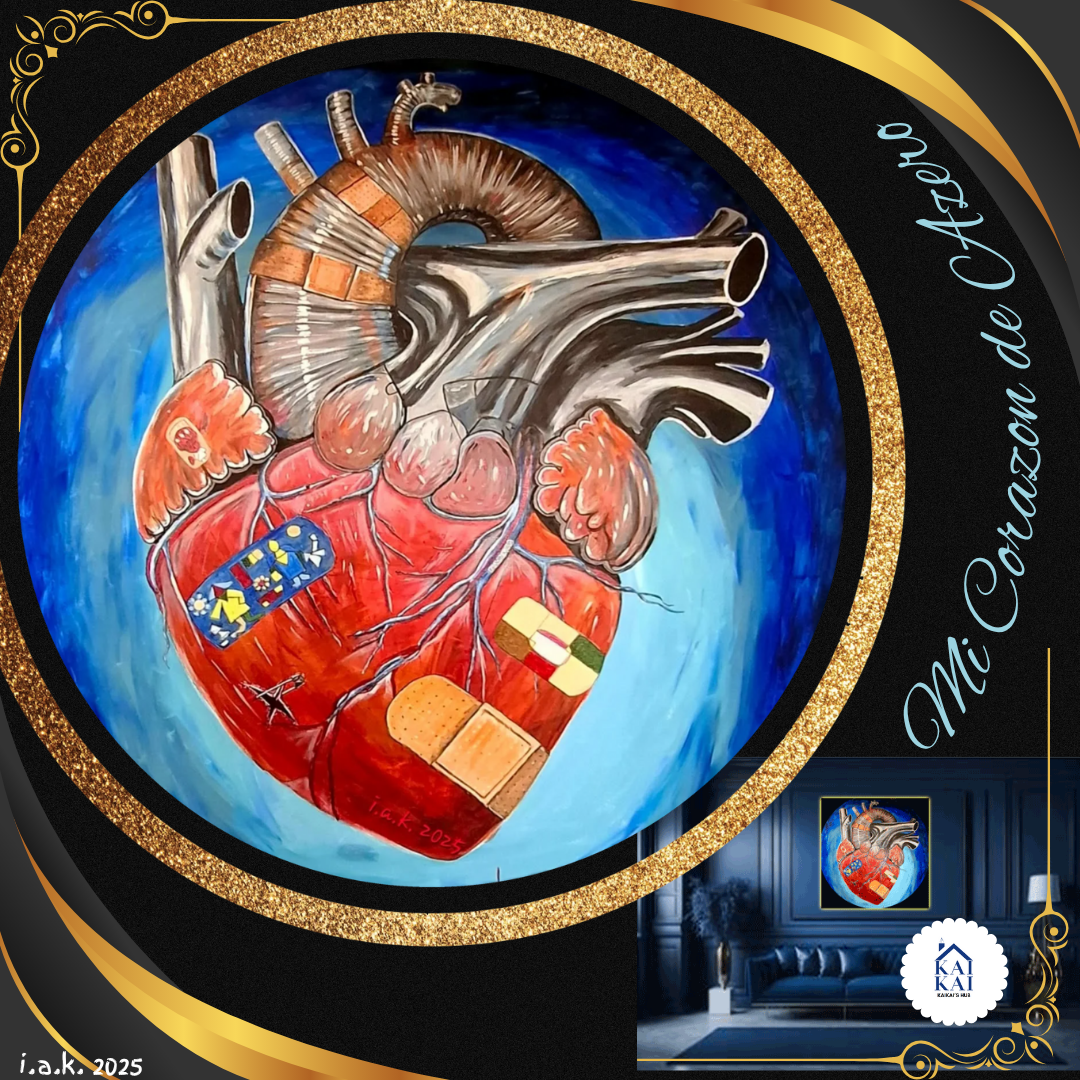
Since I'm still uncertain about the exact location for my second stent, I've decided to hold off on thinking about it until the next procedure.
......After nine weeks and a day, I underwent another angioplasty. This time, the pain on the operating table was significantly more intense. Fully awake, I found myself trying to decipher every word of their conversation, which only amplified my fear. My mind interpreted their every utterance, scaring me even further. My blood pressure soared. I had three horrifying options for my gaze: to the right, where I could see the doctor performing the procedure, watching 150 cm wires being pushed and pulled from my wrist towards my artery; straight ahead, to the monitors where, in my naivety, I saw blood oozing from the artery, foolishly interpreting it as a "leak"—perhaps an artery pricked in the process. Ignorance is truly a trap; it can bring more danger to your mental core. My third option, the vital signs monitor, I looked at far too late. What I had already witnessed had dramatically elevated my blood pressure. I feared the procedure might worsen if I couldn't calm myself. Then, I began to pray. Prayer, I realized, is always the best tool, weapon, and ally when you're trapped in your own mental state. I prayed to trust God in the process, to guide the medical team to perform their very best, and to help me trust them as well. I prayed for calmness. In an instant, the feeling of endless waiting simply vanished. The doctor then informed me that all went successfully and I would only need monitoring. This time, they didn't insert a stent; instead, it was a drug-coated balloon (DCB). We spent overnight in the ICU and were discharged the following day, with a follow-up appointment scheduled in two weeks.
Today, we're back home, and the central theme of this article—diffusing a dynamite—resonates more than ever. We are all, truly, just timed dynamites. We could "blow up" simply because our time has come, or we could self-destruct because we weren't careful, choosing instead to be consumed by negativity and depression.
Positivity, acceptance, and the conscious choice to fight for your life are the essential ingredients for diffusing your own dynamite. Find a reason, or two, or perhaps a hundred more, to make you choose life and its extension. For me, my family is the main reason, followed by my paintings—I still have so much to create. I still have so much to write, and then there are all my "treasures" to give away and organize, which my husband constantly reminds me to get rid of. Others might see them as trash, but perhaps, I'll be able to believe them soon.